Population bottlenecks contribute to the accumulation of several harmful mutations that cause age-related illnesses in killifish -- a finding that may help answer a key question about aging.
The study, published today in eLife, reveals why killifish accumulate harmful mutations that cause age-related conditions such as cancer or neurodegenerative diseases that shorten lifespan. This may help scientists better understand how lifespan evolves among populations and may lead to new insights on human aging.
The very short lives of turquoise killifish -- between three and nine months -- make them an ideal model for studying aging. Killifish live in temporary ponds in Africa that dry up for part of the year, meaning they must hatch, mature and reproduce before this happens. Their eggs survive the dry periods in a hibernation-like state and hatch when rains fill the pond again, starting a new generation.
"Different wild turquoise killifish populations have varying lifespans, and we wanted to explore the reasons behind this," explains lead author David Willemsen, Postdoctoral Research Fellow at the Max Planck Institute for Biology of Ageing, Cologne, Germany.
For their study, Willemsen and senior author Dario Riccardo Valenzano carried out field work in savanna pools in Zimbabwe to catch and collect genome samples from the killifish for sequencing and analysing in the lab. The team then compared the genomes of killifish living in the driest environments, which have the shortest lives, with the genomes of killifish from wetter environments, which live for months longer.
The short-lived killifish have very small, often isolated populations, leading to so-called population bottlenecks which, the team found, result in harmful mutations accumulating in their populations. By contrast, the longer-lived killifish have larger populations and new fish with new genetic material frequently join their populations. Over time, these larger populations make it more efficient for natural selection to remove harmful mutations.
"Limited population sizes caused by habitat fragmentation and repeated population bottlenecks increase the chance for harmful mutations to accumulate in the population," Willemsen says. "Our work may help answer a key question about aging by suggesting that population dynamics, rather than evolutionary selection for or against specific genes, contribute to this accumulation of harmful mutations that result in aging and shorter life."
The results support a model where, given the brief rainy seasons, killifish are under strong selective constraints to survive in the absence of water as dormant embryos and to rapidly reach sexual maturation and reproduce before the water completely evaporates. However, the team believes that killifish are not selected to be short-lived. Instead, harmful mutations that affect late-life survival and reproduction (together causing aging in the killifish) accumulate over generations without being constrained by selection.
"Harmful mutations passively accumulate in killifish populations, and this is even more prominent in smaller populations which happen to live in drier environments," says senior author Dario Riccardo Valenzano, Group Leader at the Max Planck Institute for Biology and Ageing, and Principle Investigator at CECAD, the Cluster of Excellence for Ageing Research at the University of Cologne, Germany. "Our findings highlight the role of demographic constraints in shaping lifespan within species and could potentially be expanded to provide new insights on aging within other animal and human populations."
Story Source:
Materials provided by eLife. Note: Content may be edited for style and length.
CHEYENNE, Wyo. (Wyoming News Now) - When fall hits, hunters can get caught up anticipating their season. But, before putting boots on the ground, make sure to have the current, correct and required licenses, stamps and permits, safety gear and proof of hunter education.
“It’s easy to overlook a simple requirement in the excitement of preparing for a hunt,” said Scott Edberg, Wyoming Game and Fish deputy chief game warden. “We want everyone to have a good hunting season and ensuring your licenses and safety requirements are in order will give you a great starting point.”
Licenses, stamps and permits
Depending on the game you are pursuing and method, hunters may need a variety of additional stamps and permits in addition to their respective licenses. If buying online, hunters need to print their stamps and permits for proof afield; stamps will not be mailed.
Confirm you have your 2020 licenses for the species and hunt area you are planning to hunt. Make sure the license is signed and with you at all times when hunting.
Game and Fish requires licensed hunters to have a valid conservation stamp in addition to licenses; some exceptions apply. The stamp is $12.50, and is valid for 12 months from the purchase date. Conservation stamps can be saved to a digital device for proof in the field. Proof of a conservation stamp purchase is also printed on a big game license if purchased prior to the license being printed.
Elk hunters in Hunt Areas 70, 71, 75, 77, 78 and 80-98 must possess an Elk Special Management Permit for $15.50 This stamp can be saved to a mobile device for proof in the field.
If you plan to hunt pheasants, you may need a $15.50 Pheasant Special Management Permit. The permit is required to hunt on Game and Fish walk-in hunting areas and any Game and Fish managed pheasant hunt and can be carried digitally on a mobile device. For a full listing of locations that require the permit, see the 2020 Upland Game Bird and Small Game regulations.
Big game hunters who plan to hunt in the special archery season must also possess one archery license in addition to their hunting license. The only exception is for holders of Type 9 archery-only licenses.
Waterfowl hunters should make sure they have their Federal Migratory Bird Hunting and Conservation Stamp (Duck Stamp). All hunters 16-years-of-age and older must have and carry a Duck Stamp to hunt ducks, geese and mergansers; it’s not required for mourning doves, sandhill cranes, coots, snipe, rails or crows. Duck stamps expire on June 30 of each year. This stamp is immediately available as an e-stamp and later mailed from the U.S. Fish and Wildlife Service.
All licensed migratory game bird (mourning doves, ducks, geese, mergansers, coots, rails, canes or snipe) hunters need to register for a Harvest Information Program (HIP) permit, including Pioneer and Lifetime hunting license holders. HIP permits are nontransferable to other states. A separate HIP permit is required in each state where you hunt migratory game birds. Wyoming HIP permits are only available on the Department website.
Anyone born on or after Jan. 1, 1966, must have hunter education — from any state — to hunt in Wyoming, unless accompanied by a registered mentor through the Game and Fish Hunter Mentor Program. Successful completion of a hunter education course is required though, regardless of age, prior to participating in the elk reduction program in Grand Teton National Park, and hunters must carry proof. “Hunter education classes are limited and very full this fall, but the Hunter Mentor Program is a good alternative to get out hunting while you plan to take a hunter education course in the near future,” said Katie Simpson, hunter education coordinator for Game and Fish. Hunters must have proof of Hunter Mentor Program participation or hunter education in the field which is their hunter safety card or certificate and can be saved on a mobile device. If a course was completed in Wyoming in recent years, that number should be printed on each hunting license and serves as proof, but hunters should check that prior to going afield.
Fluorescent clothing requirements
Big and trophy game hunters must wear in a visible manner one exterior garment of either fluorescent orange or pink while hunting during the regular hunting season, regardless of the type of weapon they choose to use. This can be a hat, shirt, jacket, coat, vest or sweater. Archers hunting in the special archery season are exempt from this requirement. Pheasant hunters are also required to wear fluorescent clothing in certain hunt areas, seasons or locations. Camo fluorescent orange or pink clothing is allowed. Please refer the 2020 hunting regulations for additional specifics
Copyright 2020 Wyoming News Now. All rights reserved.
A fish kill on a stretch of the Frankstown Branch of the Juniata River is under investigation thanks to local anglers.
“This stream is my happy place,” said angler Tina Ritchey. “It’s where I can go and get lost.”
On Monday, Ritchey was checking the river’s condition, a week after she said something caused a mass killing of fish.
Ritchey was relieved to see a crawfish — a sign the damage was not severe enough to kill off the invertebrates that a river needs for fish life.
Ritchey said she was supposed to go fishing last week so she stopped by her favorite spot along the river near the Frankstown Elementary School on Tuesday. That’s when she saw the dead fish.
It was the smell she noticed first, she said. It wasn’t a rotting fish smell, but something worse and indescribable. She checked a few more locations on the river off Monastery and River roads and found more dead fish.
So she called Creg Strock, owner of Aquatic Imitations in the Mielnik Shopping Village along Route 22 in Hollidaysburg, along with the Pennsylvania Fish & Boat Commission and the state Department of Environmental Protection.
Ritchey said she was told by Fish & Boat officials that the fish deaths were likely caused by the water being too warm due to low water levels and hot summer temperatures.
She said that would have made more sense if there hadn’t been such a large number of dead fish and had they not been warm-water fish, such as carp and bluegill.
On Thursday, after seeing the photos of the fish kill, Strock composed a Facebook post about the situation.
“People I didn’t even know sent me pictures,” Strock said Monday. “One guy sent a video by Monastery Road with dead fish everywhere.”
Strock said from all the information coming in, it seems the fish kill covered a 3-mile stretch of the river — from about where a discharge pipe from the Appvion paper mill in Roaring Spring dispenses treated water into the river.
Appvion did not respond to a request for a statement Monday.
Ritchey said to their credit, the company has regularly monitored the quality of the water below the discharge pipe.
“I have personally seen Appvion testing the water down there so I do know they test the water regularly,” Ritchey said.
Strock said that it will take some time for the river to bounce back along that section and it’s a promising sign that invertebrate life seems to have survived.
DEP spokesman John Repetz said Monday that the department responded to a complaint of dead fish near the elementary school, and a few dozen dead fish were seen there and at multiple locations upstream. He said the fish were in an advanced state of decomposition and at the time of the response river conditions appeared normal. He said the DEP is continuing to investigate.
Mike Parker, director of communications for Fish & Boat, said it was unknown at this time if pollution caused the fish kill but the commission and DEP were investigating. If it is found that fish were killed by a pollutant, steps will be taken to hold the party accountable.
Parker said with the hot weather and low water levels, the fish could have been affected by aquatic vegetation depleting oxygen levels, too.
Strock said he hopes that if the fish kill was due to a discharge and something that testing missed, changes will be made to ensure it doesn’t happen again. He said he has been in contact with state Sen. Judy Ward’s office about the issue, as well.
Ritchey said it is upsetting that something could come close to destroying a river that not only anglers enjoy, but also kayakers and canoers.
“It’s not just about fishing, it’s about enjoying what this area has to offer,” she said.
PORTLAND, Maine -- President Donald Trump wants to dramatically expand aquaculture production in the United States, but a coalition of environmentalists believes his plan would be bad for the oceans, unnecessary for food security and difficult to implement.
Trump's bid to grow fish farming is designed to address the so-called seafood deficit, which refers to the fact that nine-tenths of the seafood Americans eat comes from overseas. The seafood trade gap with other countries approached $17 billion in 2017, according to one federal government report.
The president issued an executive order in May that promised broad changes in how the U.S. regulates fish farming. It included provisions to expedite the development of offshore aquaculture in deep federal waters. That sector of the industry has yet to emerge in the U.S., where most aquaculture takes place near shore where farmers grow salmon, oysters and other popular seafood items.
The Trump administration and the aquaculture industry said the order, which is being implemented now, represents common-sense steps to ease the burden of rules on fish farmers. But environmental groups said it threatens to increase pollution and over-development in the ocean at a time when many consumers aren't buying seafood.
"They're trying to somehow connect open-water aquaculture with the need for domestic food. But it just doesn't make sense," said Marianne Cufone, executive director of the Recirculating Farms Coalition, one of several environmental groups that oppose the move. "Why we're seeing it during a pandemic, I don't know, I'm shaking my head."
The executive order gives the nation's regional fishery management councils, which regulate fisheries, six months to recommend "actions to reduce burdens on domestic fishing." One of the order's stated goals is "more effective permitting related to offshore aquaculture and additional streamlining of fishery regulations," with "the potential to revolutionize American seafood production."
The order aims to bring seafood production to the U.S. instead of keeping the nation dependent on other countries, said Paul Doremus, deputy assistant administrator for operations at the National Oceanic and Atmospheric Administration's National Marine Fisheries Service.
"We're a major seafood consuming country and we could be producing more of that seafood internally," Doremus said. "That's the driving force behind the executive order as a whole."
Hallie Templeton, senior oceans campaigner at Friends of the Earth, said it's not the right time to expand fish farming. Seafood is popular in restaurants, and the coronavirus pandemic has caused many to shutter, at least temporarily. Seafood sales to restaurants fell 90% in the early weeks of the pandemic. The industry has since seen an infusion of CARES Act money to help it recover, but continues to struggle.
Templeton called offshore aquaculture "floating factory farms" and said they are more likely to cause pollution in the marine environment than provide sustainable food.
A recent court ruling dealt a blow to the prospects for offshore fish farming. The 5th U.S. Circuit Court of Appeals said in a decision Aug. 3 that federal law granting NOAA authority over fisheries does not also let the agency set rules for offshore fish farms. That scuttled rules that could have regulated fish farms in the Gulf of Mexico.
"Allowing net-pen aquaculture and its environmental harms in the Gulf of Mexico is a grave threat, and the court properly held the government cannot do so without new and proper Congressional authority," said George Kimbrell, Center for Food Safety legal director and a lead counsel in the case.
The prospect of offshore aquaculture has been contentious for years. President Barack Obama also took steps to permit deep water fish farming during his tenure.
The aquaculture industry remains hopeful that Trump's executive order can help pave the way for more fish farming, both near shore and offshore. Paul Zajicek, executive director of the National Aquaculture Association, said the order isn't about eliminating regulations but rather "removing barriers to aquaculture permitting" for farmers.
Some fishing groups have also come out in support of the order. Scot Mackey, director of government affairs for the Garden State Seafood Association, which advocates for fishermen as well as farmers, said the order "will help the industry weather the current crisis and come back stronger."
Neville Crabbe, spokesman for the Atlantic Salmon Federation, a conservation group, said the federal permitting process should be creating land-based aquaculture rather than fish farms in the ocean, let alone offshore.
"It's not clear how locating that production just further away from the coasts would help with things like diseases and parasites and other problems that plague the industry today," he said.
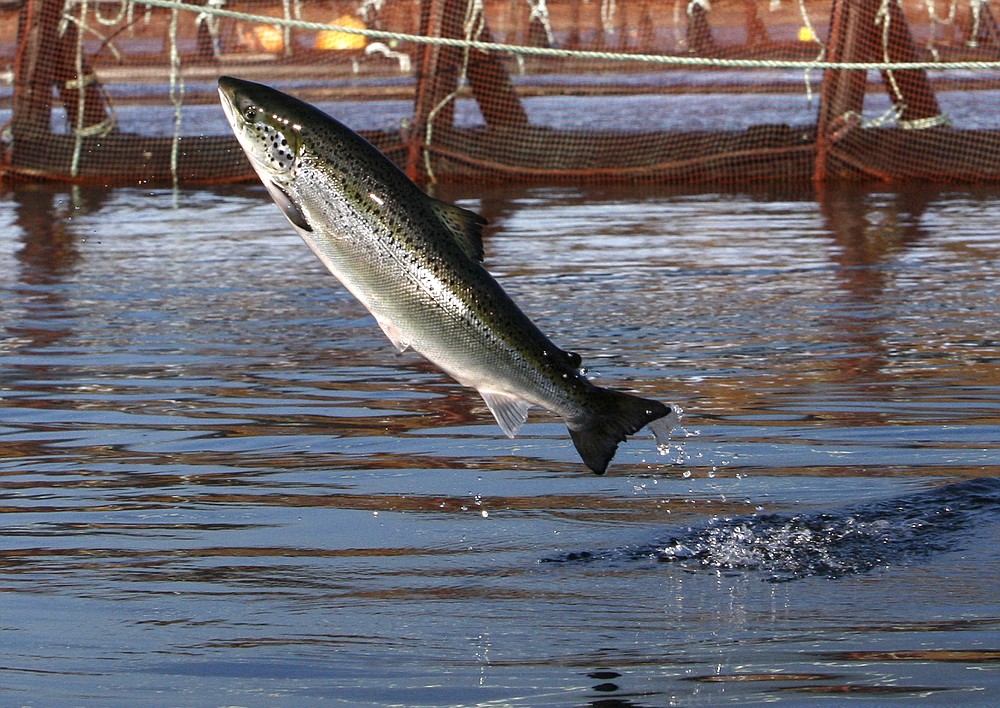
FILE - In this Oct. 11, 2008 file photo, an Atlantic salmon leaps out of the water at a Cooke Aquaculture farm pen near Eastport, Maine. President Donald Trump is hoping to dramatically upscale aquaculture in the U.S., including expanding the long controversial sector of offshore aquaculture. In May 2020, the president issued an executive order that promised broad changes in how the U.S. regulates fish farming. (AP Photo/Robert F. Bukaty, File)
Inshore fishing around Anna Maria Island is following the typical hot summertime pattern.
Hot days. Hot catches.
And BOLO for fast-moving weather.
Early morning fishing on the flats before the sun gets high is worthwhile for the catch-and-release snook and redfish.
I think picking the days to fish is the key to success. Choose days when there are swift moving tides and low light in the early morning, when water temps are slightly cooler, helping trigger the inshore species to feed.
Combining good tidal flow with a lower morning temp can result in great summertime action on the flats. As the day progresses and the sun rises, you’ll notice the shallow areas where snook and redfish forage are not as productive as during the cool of the morning.
The reason? It’s too darn hot.
If you’re willing to brave the heat, then I suggest moving to deeper water to target mangrove snapper and grouper, as well as popular migratory fish, such as mackerel and jacks.
Down deeper, where the water temps remain cooler, the bottom dwellers — snapper and grouper — remain motivated to eat. If you can venture offshore to depths of 80-100 feet, you’ll find a more accommodating bite.
Also, keep in mind that with the hottest days of the year there’s potential for pop-up storms. Keep an eye on the sky to prevent being trapped by heavy rain with lightning. Calm conditions can switch to rough waters in a second when you’re offshore. And the storms that bring lightning can be startling when you’re on a boat. Always consider your safety and the safety of your passengers ahead of your fishing goals and do the best you can do to avoid the fast-moving weather.
Capt. Warren Girle is encouraged to see the habitat of Sarasota Bay showing improvement after the devastating red tide of 2018-19.
He says bay fishing over deep grass areas is yielding a variety of species.
Catch-and-release spotted seatrout are being caught frequently, as well as jack crevalle, ladyfish, bluefish and Spanish mackerel.
And most importantly, mangrove snapper are coming on strong. Limits of the snappers are being caught in a morning of fishing by bumping from one spot to the next. It’s not a “one-stop shop,” but Girle’s anglers are putting enough in the cooler for dinner. Fishing shallow over the flats in Sarasota Bay also is yielding some good action, especially on catch-and-release redfish.
Capt. David White is concentrating inshore, where catch-and-release snook and redfish are being hooked up along mangrove shorelines at oyster bars. Casting live shiners — either free-lined or under a cork — is producing action.
Moving to the deeper grass, White is putting clients on plenty of mangrove snapper and Spanish mackerel in Tampa Bay over structure.
To mix things up, White found some juvenile tarpon that, when hooked on light tackle, are thrilling for his clients.
With bad weather and rough seas, Capt. Jason Stock limited his charters to inshore action, where the gag grouper and mangrove snapper bite in Tampa Bay kept him busy. Free-lining large baits — such as pinfish — around wrecks and rock piles in the bay was producing some keeper gags. As for the snappers, small white bait works well.
Also, while in the bay, Stock has his eyes peeled for juvenile tarpon. These small schools tend to bite more as the heat of pursuit of the silver king wanes.
Jim Malfese at the Rod & Reel Pier says mangrove snapper are the targeted species. Anglers using live shrimp as bait are catching limits of the tasty inshore snappers. In the midst of the snapper, anglers also are hooking into some catch-and-release snook and redfish.
Fishers casting jigs from the pier are hooking into jack crevalle and ladyfish for sport, but the bite is sporadic.
Send high-resolution photos and fishing reports to fish@islander.org.
High market demand led to declining numbers and a ban on arapaima fishing in the late 1990s, though illegal poaching for the black market continued.
According to a recent paper, the co-management system that has helped these fish recover also provides new opportunities for women in fishing communities.
Women working in co-management have newly independent incomes and receive previously unknown respect for their roles, though further work is needed to cement these gains.
When harvest season comes to the Amazon, Irlene das Graças da Cunha de Figueiredo’s day revolves around fish. During a handful of days every year, when the floodwaters of the river are high, she and her community of São Raimundo share a singular purpose: harvesting a massive fish they call pirarucu. Irlene is in charge of a group of women who process these fish.
From dawn to dusk, they work quickly to eviscerate thousands of pounds of pirarucu before immersing them in ice to be shipped to market.
It’s hard work, but it’s a dramatic change compared to just a few years ago, when Irlene worked in agriculture for subsistence — but received no income. Thanks to a co-management system that engages Amazonian communities in the management of pirarucu, also known as arapaima, women like Irlene can now earn their own income independent of their husbands or fathers.
In many communities, women have also gained a level of respect within the fishing industry that previously did not exist.
“The biggest change was learning, with the exchange of knowledge of women working together, to see the strength of women, their enthusiasm to get an income that they can say that is only theirs,” Irlene wrote in a WhatsApp message about her experience in the fishery. “This joy of having their own money and deciding alone how you will use it is very rewarding, and increases women’s freedom.”
A new study led by Carolina Freitas, a recent Ph.D. graduate of Universidade Federal do Rio Grande do Norte, quantifies how co-management has begun a process of “un-invisibilization” for women in these communities. Through interviews with 143 women living in 54 fishing communities along the Juruá River, Freitas’s team found that women working in arapaima co-management communities earned a median annual income of $215. In communities without this system, the median annual income for women was zero.
“We say that the arapaima is like the fish of change,” co-author João Campos-Silva, an ecologist at Universidade Federal de Alagoas and postdoctoral researcher with the Norwegian University of Life Sciences, said in a video interview. “The arapaima can show how we can build a development pathway for Amazonia.”
New system, new opportunities
Arapaima (Arapaima gigas), a large Amazon freshwater fish. Photo by Jeff Kubina on Flickr.
Stretching more than 3 meters (10 feet) long and tipping the scales at 180 kilograms (400 pounds) or more, arapaima are the planet’s largest scaled fish. In the 1990s, they were also one of its most endangered, thanks to overfishing and a furious black market. Their numbers dropped so low that arapaima fishing was banned, though the ban did little to stop illegal poaching.
That began to change in the early 2000s, when IBAMA, the Brazilian environmental agency, introduced co-management. Under this system, fishing communities themselves estimate the annual abundance of arapaima in their region. During the August-to-November dry season, when the arapaima are confined to small ponds, the villagers count them directly. This is made possible by the fact that these unusual fish must surface roughly every 15 minutes to breathe air.
The system also reduces poaching by requiring communities to protect the ponds where these fish shelter when river levels are low, and paying them to monitor for offenders. Fishing for arapaima is still banned outside co-management areas, and within them, villages that receive a quota have a season of only two to five days to harvest it.
Though women had always participated in this fishery in some way, they historically weren’t recognized or compensated for their work. Hauling in the enormous catch was limited to men, a skill passed down from father to son. According to the study authors, duties like cooking at fishing camps or cleaning the catch were seen as an extension of women’s household duties, and therefore went unpaid.
With the new system came such an abundance of work that, in many communities, it simply couldn’t be done by men alone. Women began filling many different roles, from counting the arapaima, to measuring them for IBAMA reporting, to preparing them for delivery to market, and even to harvesting them during the brief, intense open season.
Freitas first saw this while doing her Ph.D. research on arapaima co-management, when she followed along during the harvest.
“Talking with them, I started to notice how significant their participation was, how it embedded so many implications,” Freitas wrote in an email to Mongabay. Her team found that as women moved into these new roles, some of their neighbors began to endorse them as important members of the fishery. “Once this empowerment starts to happen in any activity, it will naturally affect women empowerment as a whole — in their daily lives, in their household, in their community.”
The financial benefits of this participation are also notable, as the $215 in median annual income that the researchers found is a considerable sum locally.
This money likely has an effect that extends well beyond the individual, said Sarah Harper, a postdoctoral researcher studying women in global fisheries at the University of British Columbia’s Institute for the Oceans and Fisheries, who was not involved in the arapaima study. According to Harper, when women earn an independent income, that money often disproportionately goes toward family-focused resources like children’s education and more nutritious food.
“It helps shift the dynamic within the household, and can create a condition for women to be more self-sufficient,” Harper said. “Women’s ability to make strategic life decisions is bolstered by needing to make an income. And often that’s to the benefit of their families and children.”
The Juruá community as a whole also benefited from this influx of capital, which allowed for the purchase of new boats and funded health care that was previously out of reach.
And all the while, the fish central to these changes have been finning toward recovery. In a 2019 paper, Campos-Silva and his co-authors found that arapaima populations had increased in all but one protected lake between 2005 and 2016, with an average growth rate of 76%. In one lake, the population saw a veritable boom, increasing by 1,129.9%.
Securing women’s roles into the future
A community in Brazil harvests arapaima, the largest scaled freshwater fish in the world. Photo courtesy of Carlos Peres.
However, there’s still work to do to continue the social progress beginning to flow through the Amazon. Co-author Priscila Lopes, a professor of ecology at Universidade Federal do Rio Grande do Norte who studies women in fisheries throughout Brazil, noted that empowerment helps fisherwomen realize the inequality that pervades the systems around them. For example, Lopes said that when women went to small local hospitals for health problems caused by fishing, they found doctors and nurses didn’t believe their stories, particularly if they came in with painted nails or with their hair done.
And in many communities that Freitas’s team studied, both within and outside co-management areas, decision-making in fisheries still remains stubbornly male-dominated.
Harper said that, because female empowerment was a secondary effect of the management system, this piece of the system may naturally be resistant to change. She also noted that there was no guarantee that women’s roles in these communities would remain if the fishery changed.
In other fisheries, NGOs have seen success from offering workshops focused specifically on breaking down gender norms. These targeted discussions, alongside structural changes — such as providing childcare during fishery meetings — could bring women into the decision-making process and make these gains more robust.
Freitas and Campos-Silva expressed hope that these sorts of changes are on the horizon. Their experiences in the Amazon inspired the two researchers to found Instituto Juruá, a nonprofit focused on bringing sustainable management, grounded in local knowledge and equality, to more Amazonian communities.
“To me, sometimes when we talk about conservation with conservationists, it seems to be something that is at the end of the pathway — something you need to achieve,” Campos-Silva said. “But for us conservation should be a way of life. Should mean a better life. And I think that we can really develop another paradigm of local development and conservation in Amazonia, and I hope we can see it on a large scale in the near future.”
Banner image: Arapaima can grow to 200 kilograms (440 pounds), and it is an important source of protein and income in the Amazon. Photo courtesy of Carlos Peres.
Citations:
Freitas, C. T., Espírito-Santo, H. M. V., Campos-Silva, J. V., Peres, C. A., & Lopes, P. F. M. (2020). Resource co-management as a step towards gender equity in fisheries. Ecological Economies, 176. doi:10.1016/j.ecolecon.2020.106709
Campos‐Silva, J. V., Hawes, J. E., & Peres, C. A. (2019). Population recovery, seasonal site fidelity, and daily activity of pirarucu (Arapaima spp.) in an Amazonian floodplain mosaic. Freshwater Biology, 64(7), 1255-1264. doi:10.1111/fwb.13301
A proposed deep-water fish farm about 40 miles off Florida’s coast could reshape the world’s seafood industry and upend the lives of the region’s fishermen.
If approved, Velella Epsilon would be the first aquaculture project in federal waters off the contiguous United States. There, globe-shaped pens would cultivate up to 64 million pounds of sushi-quality almaco jack fish meat each year, creating stiff competition for those who ply the Gulf’s wild-catch fisheries, as well as opportunities for fishermen hoping to supply bait for the project.
At stake is whether markets and permits are enough to tackle the larger ethical questions about how to integrate fish farming into the complexities of a system that includes not just the Gulf of Mexico, but Americans who make a living off it.
“How much of the landscape and the seascape should human beings be using?” asks Philip Cafaro, a philosophy professor at Colorado State University. “You have to be explicit about what your goals are. If it’s to maximize profits in the fishing industry, that’s one thing. If your goal is to maximize output to the fishing industry in order to protect communities, that’s a very different one.”
CORTEZ, Florida
The long, choppy quest to open up the Gulf of Mexico to large-scale fish farming began, in a way, some 30 years ago on the black pearl diving docks of Micronesia. That’s where the Australian businessman Neil Anthony Sims first met the American marine biologist Kevan Main.
Their paths diverged – his to Hawaii to develop deep-water fish farming, hers to Florida to head the Mote Marine Laboratory & Aquarium in Sarasota – but the two remain key figures for a project that could transform not just the American dinner table, but also the economies of fishing ports from Alaska to Florida.
Velella Epsilon – the first fish farm in federal waters off the contiguous United States – would operate in the Gulf of Mexico, about 40 miles from Florida’s coast. Globe-shaped pens would hold fingerling almaco jack, a member of the amberjack genus, that would grow into 4-pound market fish within a year. If scaled with corporate investment, the project could eventually yield 64 million pounds of sushi-quality meat a year, enough to dramatically reshape the world’s seafood trade.
“People paying attention to the global impacts of humankind on the planet are saying we need more aquaculture, and offshore fish farms are a really scaleable, sustainable, low-impact form of aquaculture,” says Mr. Sims, the co-founder and CEO of Ocean Era, the company behind the Velella Epsilon project, in a phone call from Hawaii. “There’s deep water. You are further from shore. The currents are better. You work within the assimilative capacities of the system.”
Patrik Jonsson/The Christian Science Monitor
Cortez, Florida, is one of dozens of fishing communities across the US that could either benefit from or be hurt by the prospect of large-scale, corporate fish farming in US offshore waters. Like many such communities, it is filled with colorful characters and funky displays of individualism.
As Velella Epsilon gains steam even under heavy regulatory headwinds, that phrase – “assimilative capacities,” the ability for the natural environment to safely absorb pollutants – will be key in a broader gambit for U.S. protein independence. At stake is whether markets and permits are enough to tackle the larger ethical questions about how to integrate fish farming into the complexities of a system that includes not just the Gulf of Mexico, but Americans who make a living off it.
“How much of the landscape and the seascape should human beings be using?” asks Philip Cafaro, a philosophy professor at Colorado State University in Fort Collins. “You have to be explicit about what your goals are. If it’s to maximize profits in the fishing industry, that’s one thing. If your goal is to maximize output to the fishing industry in order to protect communities, that’s a very different one.”
In a big pond
In 1986, the newly independent Federated States of Micronesia imported nearly 20,000 pounds of black-lipped pearl oysters, a species known for its high quality black pearls, and raised them in Chuuk Lagoon. At first, little was done to develop the fledgling republic’s nascent aquaculture.
But as Micronesia’s black pearl industry began to shift to a more managed model in the 1990s, “we saw a transition from hunter-gatherer to farmer,” says Mr. Sims. “And it took years of bitter fighting. But now those communities have reversed a brain drain because there are now millionaires in those communities.”
Mr. Sims’ goal off the coast of Florida is much the same, he says. “The primary driver behind Velella Epsilon is to showcase it to the fishing community as a great asset.”
Patrik Jonsson/The Christian Science Monitor
A 28-day-old almaco jack hunts for live brine shrimp in a beaker at the Mote Marine Laboratory on the outskirts of Sarasota, Florida, on Aug. 20, 2020. Spawned from a wild broodstock caught from local waters, the fish can grow to near-market size within a year. It is part of an offshore farming demonstration project planned some 40 miles off the coast of Florida.
It's now unclear which government agency has authority to approve the Velella Epsilon project, but which would test the feasibility of fish farming in a high-risk environment. It also represents the latest effort to push aquaculture through the regulatory maze that binds the National Oceanic and Atmospheric Administration (NOAA) to eight regional fishery councils, which in turn set the rules for managing the wild stock.
The White House appears eager to open federal waters to aquaculture. With Executive Order 13921, President Donald Trump on May 7 ordered NOAA to winnow down regulations for both aquaculture and wild-caught fish. Last week NOAA announced that it would be creating 10 Aquaculture Opportunity Areas, including one in the Gulf.
But this push for open-ocean fish farming has faced legal hurdles. Earlier this month, a federal appeals court ruled that NOAA lacked the authority to take the lead in regulating aquaculture in federal waters, a victory for the environmental groups and fishing associations who brought the suit. Those groups have argued that open-sea aquaculture is too risky and too dependent on the market’s whims.
“A slice of the population looks at the oceans and thinks of them as a last, wild frontier, and to have farming in that last wild frontier is anathema to them,” says Paul Zajicek, executive director of the National Aquaculture Association in Tallahassee, Florida.
Ocean aquaculture is not without its environmental costs, such as escaped fish, parasites, and “fish sewage.” Though some of those problems are more endemic to near-shore fish farms, concerns remain among environmentalists and many Florida residents that deep-sea cultivation would prove even more complex, but with less oversight.
“It’s an ethical issue akin to raising tigers for consumption: You’re fishing up the food chain,” says Zach Corrigan, a senior attorney at the Washington-based nonprofit Food & Water Watch, which opposes the project. “I don’t think [Mr. Sims] represents what is really the best economic model for these fish farms, which is going to be cheaply produced fish out there on the fly. At that point you’re not competing against the imports, you’re producing expensive, high-grade product for your own dollars.”
Patrik Jonsson/The Christian Science Monitor
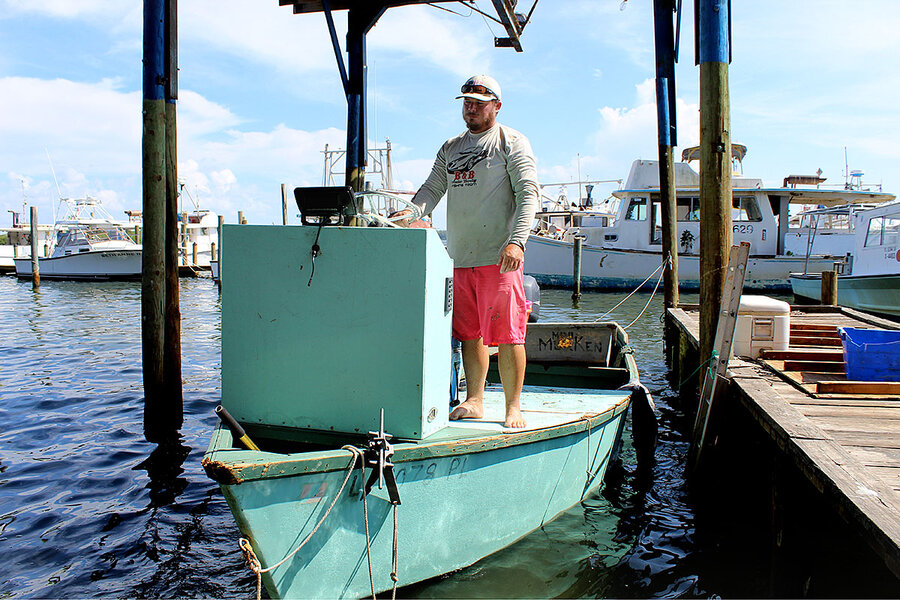
Commercial fisherman James Bois stands astride his hand-built fishing boat at the docks of Cortez, Florida, on Aug. 20, 2020. Commercial fishermen have to be not just adept at finding and catching fish, but also managing their money from a range of activities that, for Mr. Bois, includes everything from fishing for bait to work trips to Alaska for summer salmon. As for offshore fish farms, Mr. Bois says, "100 percent, we will be affected."
Opening a can of worms
To James Bois, a commercial fisherman based here in Cortez, it’s unclear how a massive fish farm operation off the coast of Cortez will change his life. But he does know that unless Americans suddenly start consuming more seafood, his wild-caught fish – amberjack is on his list of allowable catch – will have to compete against Mr. Sims’ farmed almaco jack.
At the same time, fishing regulations deemed necessary to protect vulnerable stocks have reshaped Cortez. Today, the funky little slice of pre-Disney Florida is largely a bait fishery for larger fleet boats. If Mr. Sims began buying local bait to feed his fish, it could create a boom for Cortez, in the short term. Yet part of the plan to make open-ocean farming truly sustainable is to replace bait fish with a plant-based feed laced with algae oil. It takes 5 pounds of feed to build 1 pound of fish protein.
“Offshore farming can help us or hurt us. We don’t know which yet,” says Mr. Bois. “But one thing I know 100%: It will affect us.”
Market dynamics, court battles, and political battles seem far on the horizon from the Mote Marine Laboratory & Aquarium, on the outskirts of Sarasota. There, Ms. Main runs her marine workshop: tubs, PVC pipes, and notes on pH and salinity scrawled on wipe-boards. Ms. Main is the aquaculture scientist who solved the mystery of spawning snook. She helped pioneer pompano as a farmed fish. She has also farmed sturgeon and redfish.
Mote Marine Laboratory & Aquarium, Ms. Main points out, is not involved in the planning or operation of Velella Epsilon. But Mote has been contracted to provide some 20,000 fingerlings for the project’s initial cohort of fish.
As she leans over a massive tank, she points to 28-day-old almaco jack fry gorging on brine shrimp. “Look at those little tiny row boats,” she says.
Indeed, her problems are far more immediate, given her hopes to have the demonstration pen operating by December. She is losing more of the almaco jack fry than she was expecting, forcing a reevaluation of the feeding plan.
Get the Monitor Stories you care about delivered to your inbox.
But what’s harder to control than salinity is perception. In a way, how a dream to farm the open oceans clashes with shifting values on land is embodied by her work.
“We should be producing food that we eat in this country,” she says. “It’s really important, because we will do it right, it’ll be subject to our regulations, and we know what we’ll be getting.”