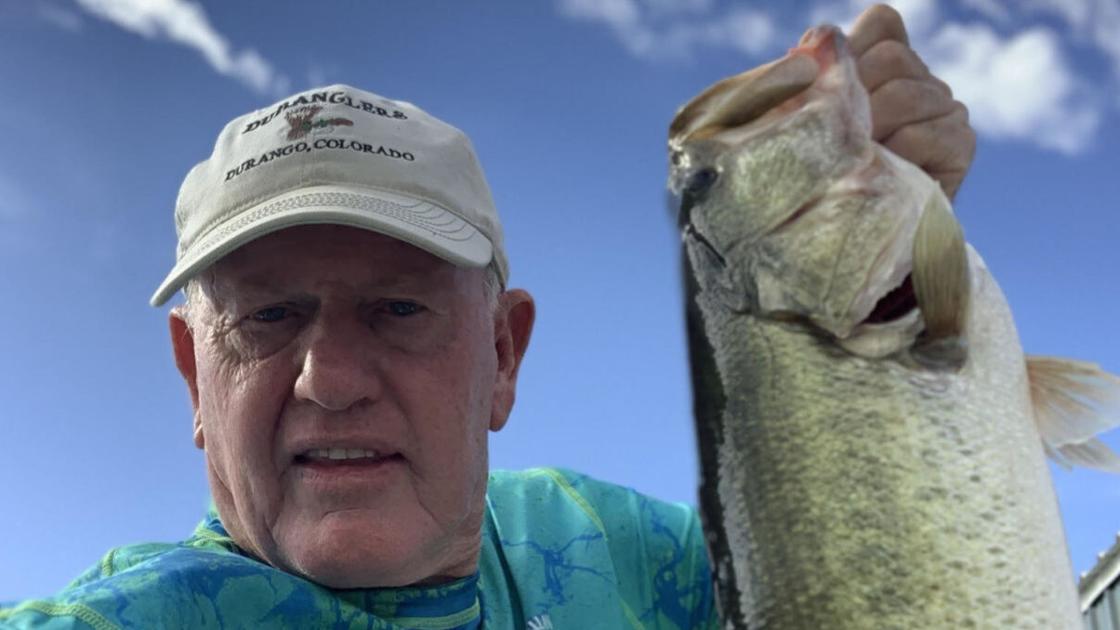
Centex angler James Crow with a 6-pound largemouth bass he caught at Lake Waco. It was among 12 that he caught on that trip using a spinning combo and ATX Lures.
James Crow photo
If you’ve spent any amount of time on a Central Texas lake during the summer, you’ve likely witnessed a phenomenon that made you do a double-take the first time you saw it.
During the summer months, white bass prowl the lake in huge schools and feed on shad and other bait fish, which also school up together. When white bass get ready to really strap on the feed bag, they herd schools of bait up toward the water’s surface to make it easier to attack.
The resulting action makes the water’s surface appear to be boiling, as hundreds — and sometimes thousands — of fish crash and splash the water to feed on the trapped shad. The first time I noticed a white bass feeding frenzy was when I was 12. My family and a few other families got together by the old Bosque Bend Clubhouse to cook out, swim, and spend the day by the water.
We kids always packed along our fishing gear — and still do — just in case the opportunity came along, and while I was scarfing down a burger, I looked out and saw acres of white bass in surface-feeding mode.
I forget what happened to the burger, but within a minute, we were cranking in fish as fast as we could get the bait out, and the action continued for around half an hour. Occasionally, the school would push away from the shore, so we had to wade further into the water, but soon, we’d see and hear fish feeding between us and the bank. I caught several fish on backward casts just to say I had.
After about 30 minutes, a boat came blasting through and sent the school scattering, so we made our way back to the grill and fixed up another plate.
Patience and stealth are hard qualities to come by when you eyeball surface-feeding activity, because you know that anything you throw into the school — even a bare hook — will elicit a strike. However, you won’t catch a thing if you spook the fish by running into the area too fast and too loudly. Kill the big engine and drift or use your trolling motor to ease in, then make long casts into the school.
The limit on white bass is 25 per angler per day, and fish must measure at least 10 inches in length. Keep in mind that hybrid-striped bass can also be caught in the same schools with whites, so know how to tell the difference. The limit on hybrids is 5 per angler, and there’s an 18-inch minimum on them. Google can show you the difference and save you from trouble with the game warden.
Cats and bass are biting
Catfishing legend Danny King says while recent triple-digit temperatures were too hot for him, he’s heard plenty of good reports from anglers — especially on night-time trips.
“Big flatheads and blues are coming off their nests,” he said, “and some good-sized fish are being caught.” After spawning, which saps fish of energy, they leave their spawning beds and go out to put some calories back into their bodies. And while post-spawn fish have typically lost some weight through the process, they make up for smaller size by being more aggressive feeders.
King says that another category of catfish are also actively feeding these days. “Some people are complaining about all the little nibblers that steal their bait,” he said, “but that’s a good sign that last year’s spawn is out full-blast. Those sharp-toothed eight to ten inch fish will drive you crazy, but that’s Mother Nature doing her job.”
King added that he’s finding plenty of sand bass surface-feeding on lakes across the region.
Area angler James Crow is also seeing lots of sandies on the surface, and has also been catching good numbers of largemouth bass using baits from ATX Lures.
Licensed to kill
2020-2021 hunting and fishing licenses go on sale in less than two weeks (Aug. 15), and buying early has replaced the long lines that used to mark opening day of dove season on Sept. 1.
A variety of licensing options are available depending on your plans, but the most comprehensive and economical is the Super Combo license, which includes both a fishing and hunting license; freshwater and saltwater endorsements with a red drum tag; and upland game bird, migratory game bird, and archery endorsements. The only thing not included is the Federal Duck Stamp for waterfowl hunters.
Catching fire
Congratulations to the readers who entered and had their names drawn for the sample pack of Pull Start Fire. I’ll contact winners by e-mail on Monday to make arrangements. Unfortunately, most of Central Texas is now under a burn ban, but maybe we’ll get enough rain soon to wipe the slate clean.
I’ve used Pull Start Fire twice, each time on a burn pile, and all it takes is a pull of the string to get things ablaze. It’s a great addition to an emergency kit, camping pack, hunting camp, or any time you need a reliable way to start a fire — no matter the weather or how wet your wood.
TSTC meat market
I’m fortunate that my folks taught me how to cook when I was young. I generally prefer my home cooking over any restaurant — with a handful of exceptions. I can’t make pizza like Poppa Rollo’s, and my fajitas are on the verge of excellent, but never reach the level of Casa de Castillo’s.
Growing up, we got most of our steaks, ground beef, pork chops, and other meat from TSTI (now TSTC). My dad’s office was on the campus there, and he’d swing by the meat market once a week to pick up cuts that the students there had done for their grades, so the quality was better than you could get at a grocery store.
Last weekend, I heard during a Zoom meeting that the TSTC Culinary Arts department is still at it, and their meals even include venison, rabbit, duck, and other game meats. There’s also plenty available to satisfy a sweet tooth. You can pay by phone and arrange for pickup off campus.
For more information, call 254-867-4868.
Best wishes and prayers for healing go out to Shirley Rodriguez, mother of Tribune-Herald outdoor column contributor Keith Rodriguez. Shirley was hospitalized last weekend, and after a bumpy stretch, Keith reported that her road has smoothed out. Maybe she just needs a dose of fried crappie fillets.
Honey Creek’s bass, crappie and catfish scored a major housing upgrade this week with an initial down payment of just $5,000 from the City of Grove.
The newly upgraded Fish Attractor Locator Map on the Oklahoma Department of Wildlife Conservation website now shows 11 new red dots on Honey Creek, where that initial contribution of $5,000 resulted in about 10 times that in fish habitat improvement work thanks to federal matching funds and contributions from Mossback fish habitats of Springdale, Arkansas, according to Josh Johnston, northeast region fisheries supervisor.
Unlike typical “spider blocks” made of concrete and round plastic pipe, Mossback creates its structures from recycled plastic that is textured and has flexible V-shaped cross-members on large vertical pipes. The flexible “limbs” are designed to collect silt, but not snag lures, and to promote growth of moss and other vegetation.
Mossback was enthusiastic about the effort, Johnston said.
“They delivered all the materials and three guys were here all day, including the owner, and they helped us assemble the blocks and put everything out,” he said.
Funding for the project began with the Grove City Council, which kicked in $5,000 for a habitat improvement project, he said.
The wildlife department was able to get a 3-to-1 match on the council’s contribution with Federal Aid in Sportfish Restoration Act funding, and Mossback not only offered materials at a 45% discount, but it also donated an additional 10 structures to place around the fishing dock at Honey Creek State Park, he said.
The 11 fish-attractor sites each are made up of 15 to 30 habitat structures and “cover quite a bit of area,” Johnston said. “I’m hoping they will attract and hold quite a few fish.”
“I had hoped for a project of about $22,000, but with everything considered it’s probably closer to about $50,000 in value,” Johnston said. “We hope to work with Mossback again and the city. This would not have happened without that initial contribution from Grove.”
Anglers can find the structures using the map at wildlifedepartment.com, which describes each site and gives GPS coordinates. Anglers with even the most basic depth finders should have no problem locating the new “brush piles,” Johnston said.
Turkey Mountain
HIKING AND BIKING TRAILS
Tulsa's nearest available off-the-sidewalks hiking trails are located at Oxley Nature Center at Mohawk Park, 5701 East 36th St North, Turkey Mountain Urban Wilderness Area, South Elwood Ave., and the Redbud Valley Nature Preserve, 161st East Ave. Catoosa.
Daniel and Jennifer Eubanks with their children Johnye and Michael begin a hike at Turkey Mountain on Wednesday. STEPHEN PINGRY/Tulsa World
Redbud Valley Nature Preserve
Tulsa World file
Turkey Mountain
HIKING AND BIKING TRAILS
Visitor centers are closed but maps and guides for each area are available online: Turkey Mountain at riverparks.org.
IAN MAULE/Tulsa World file
Oxley
HIKING AND BIKING TRAILS
Oxley Nature Center is at Mohawk Park, 5701 E. 36th St. North.
STATE PARKS State parks are located near all of our local reservoirs, be it Keystone Lake State Park, Sequoyah State Park at Fort Gibson Lake or Arrowhead State Park at Lake Eufaula. The TravelOK.com web site lists them all and the amenities offered.
MIKE SIMONS/Tulsa World file
Natural Falls State Park
STATE PARKS
Natural Falls State Park, east on U.S. Highway 412, features a 77-foot waterfall, 4.5 miles of well-marked trails, camping and picnic areas.
Tulsa World file
Sequoyah State Park at Fort Gibson
Tourism information centers and state park lodges, nature centers, group camps, dining halls and community buildings at the state parks are closed through April 15, but rental cabins, campgrounds and outdoor sites will remain open.
Oklahoma BioBlitz
Osage Hills State Park
STATE PARKS
Osage Hills State Park, located on Highway 60 between Bartlesville and Pawhuska, features a fishing lake, stream, and miles of hiking and mountain bike trails in a historic spot.
Kelly Bostian/Tulsa World file
Nickel Preserve
NATURE CONSERVANCY
Two properties of the Nature Conservancy are within a 90-minute drive of Tulsa, the John T. Nickel Family Nature & Wildlife Preserve northeast of Tahlequah, and the Joseph H. Williams Tallgrass Prairie Preserve north of Pawhuska.
The 17,000-acre Nickel Preserve is a wilderness area with no facilities. It has three designated hiking trails open daily during daylight hours. Most access is along scenic county roads that are favorite routes for bird watchers and other lovers of nature. Learn more under the Oklahoma link at nature.org
Mike Simons/Tulsa World file
Tallgrass Prairie Preserve
Harvey Payne, community relations coordinator at the Tallgrass, said bison calves will be born through April on the 40,000-acre preserve, the wild prairie is beginning to show signs of spring growth and new migrating birds are present on any given day, he said. The visitor center and restrooms are closed until further notice but most of the preserve is viewed from county roads and scenic turnouts, or the hiking trial located near the visitor center. More about the Tallgrass also can be found at nature.org.
Tulsa World file
Lake Bixhoma
FISHING
Wildlife Department offices are closed, but licenses can be purchased online and most local bait shops are open.
Nearby lakes that offer good fishing in addition to picnic and playground amenities include community lakes like Pretty Water and Sahoma lakes near Sapulpa, Bixhoma Lake near Leonard, and Claremore Lake, east of Claremore.
Tulsa World file
Fishing at Garnett Pond
FISHING
Fishing is picking up with longer daylight periods.
The Garden Ridge Pond, off Garnett Road near the intersection of Highway 169 and the Broken Arrow Expressway, is a water-control project pond that has been stocked with bass and bluegill by the Wildlife Department. There are no amenities but bankside fishing is easily accessible. Parking can be found at large nearby business parking lots.
Kelly Bostian/Tulsa World file
Mohawk Park pond
FISHING
Several local ponds, including ponds at Mohawk Park, have been stocked by the Wildlife Department. They are listed in the department’s Close To Home fishing link on its web site at wildlifedepartment.com/fishing/tulsa-urban-fisheries.
Tulsa World file
Veterans Park Pond
FISHING
The fishing pond at Veterans Park in Jenks off Elm Street near the Creek Turnpike is a local best-bet fishery. It has ample shoreline access, two fishing docks that are ADA accessible, and offers big bass that are catch-and-release only, bluegill and catfish, as well as some remnant rainbow trout still left from wintertime stockings.
Kelly Bostian/Tulsa World file
Fishing
Fishing on local rivers and creeks for white bass should pick up as flood waters recede and snagging for paddlefish will be in high gear on the Grand River system, although the Paddlefish Research Station near Miami has been closed along with other Wildlife Department offices due to coronavirus worries, Johnston said.
New Hampshire Fish and Game is warning Granite Staters and visitors about an increase in bear encounters over the past month. Viewer video recently sent to WMUR shows a black bear helping itself to a snack from a dumpster in Lincoln. This is one of several encounters this month, says New Hampshire Fish and Game."This year we're definitely seeing an increase. Particularly over the month of July. It's been a very busy month,” said Andy Timmons, of New Hampshire Fish and Game.Timmons says that increase is caused by a couple factors."One is the very dry weather conditions that we've had in the beginning of the summer. It certainly had an impact on natural food sources for bears, specifically the berry crops,” said Timmons.Fish and Game says the ongoing pandemic may also play a role with more people staying home or staying local during vacation."That is influencing where people are, how many people are visiting the state and where people are spending their time recreating,” said Timmons. Timmons says a majority of the calls are coming from the North Country, which is home to many campgrounds and hiking trails. "The campgrounds are very full. Most campground owners I’ve talked to, including state campgrounds, are all reporting record seasons and an unbelievable amount of people camping. So obviously more people, more food attractants,” said Timmons.Timmons adds his team has also responded to an increase in reports in residential areas. "I think because people are home more, they're perhaps feeding birds. Because hey you're home, why not try to watch some birds? I think people are getting into raising chickens because they are home more. So those are two things that can certainly cause a fair number of bear conflicts,” said Timmons.
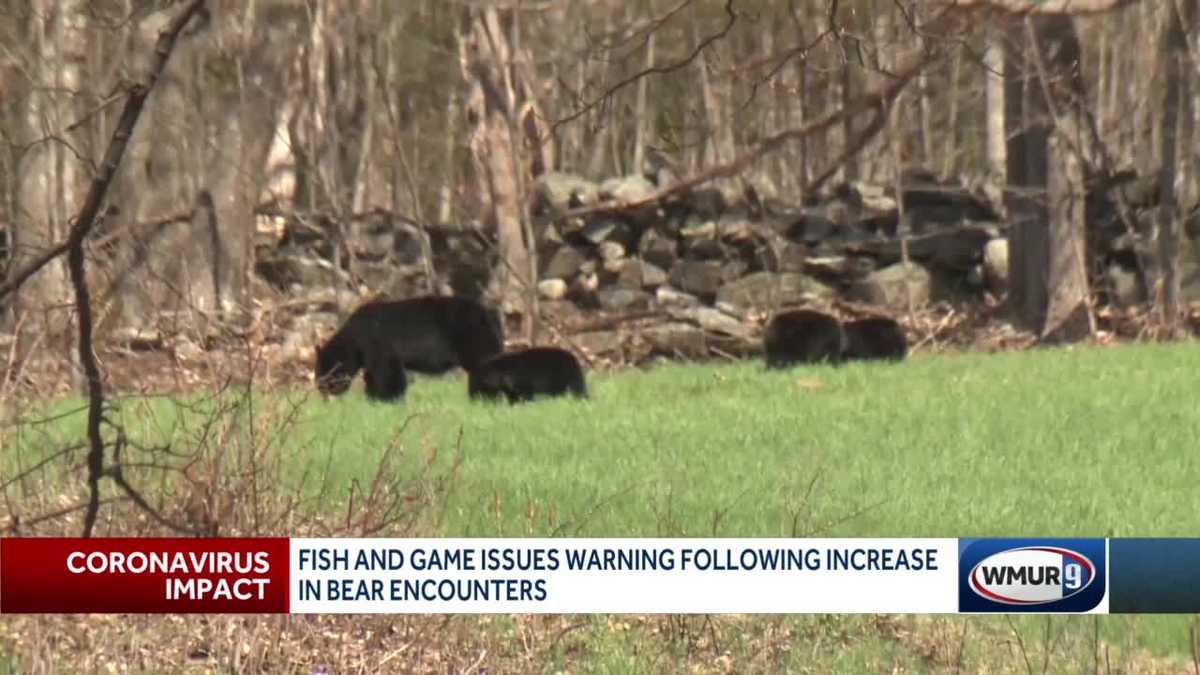
New Hampshire Fish and Game is warning Granite Staters and visitors about an increase in bear encounters over the past month.
Viewer video recently sent to WMUR shows a black bear helping itself to a snack from a dumpster in Lincoln.
Advertisement
This is one of several encounters this month, says New Hampshire Fish and Game.
"This year we're definitely seeing an increase. Particularly over the month of July. It's been a very busy month,” said Andy Timmons, of New Hampshire Fish and Game.
Timmons says that increase is caused by a couple factors.
"One is the very dry weather conditions that we've had in the beginning of the summer. It certainly had an impact on natural food sources for bears, specifically the berry crops,” said Timmons.
Fish and Game says the ongoing pandemic may also play a role with more people staying home or staying local during vacation.
"That is influencing where people are, how many people are visiting the state and where people are spending their time recreating,” said Timmons.
Timmons says a majority of the calls are coming from the North Country, which is home to many campgrounds and hiking trails.
"The campgrounds are very full. Most campground owners I’ve talked to, including state campgrounds, are all reporting record seasons and an unbelievable amount of people camping. So obviously more people, more food attractants,” said Timmons.
Timmons adds his team has also responded to an increase in reports in residential areas.
"I think because people are home more, they're perhaps feeding birds. Because hey you're home, why not try to watch some birds? I think people are getting into raising chickens because they are home more. So those are two things that can certainly cause a fair number of bear conflicts,” said Timmons.
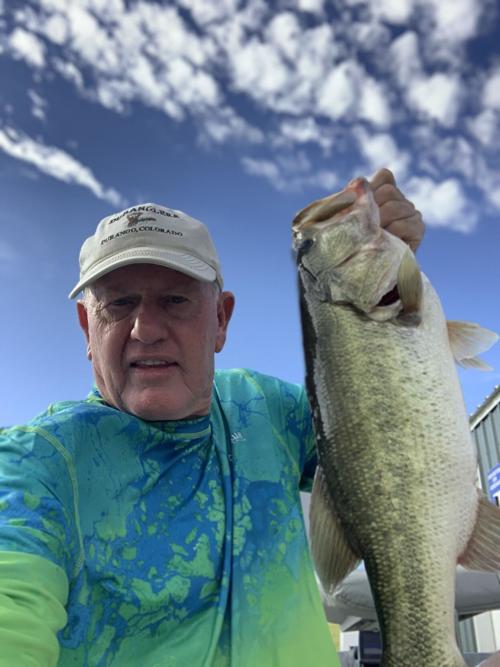
Centex angler James Crow with a 6-pound largemouth bass he caught at Lake Waco. It was among 12 that he caught on that trip using a spinning combo and ATX Lures.
Photo courtesy of James Crow
If you’ve spent any amount of time on a Central Texas lake during the summer, you’ve likely witnessed a phenomenon that made you do a double-take the first time you saw it.
During the summer months, white bass prowl the lake in huge schools and feed on shad and other bait fish, which also school up together. When white bass get ready to really strap on the feed bag, they herd schools of bait up toward the water’s surface to make it easier to attack.
The resulting action makes the water’s surface appear to be boiling, as hundreds – and sometimes thousands – of fish crash and splash the water to feed on the trapped shad. The first time I noticed a white bass feeding frenzy was when I was 12. My family and a few other families got together by the old Bosque Bend Clubhouse to cook out, swim, and spend the day by the water.
We kids always packed along our fishing gear – and still do – just in case the opportunity came along, and while I was scarfing down a burger, I looked out and saw acres of white bass in surface-feeding mode.
I forget what happened to the burger, but within a minute, we were cranking in fish as fast as we could get the bait out, and the action continued for around half an hour. Occasionally, the school would push away from the shore, so we had to wade further into the water, but soon, we’d see and hear fish feeding between us and the bank. I caught several fish on backward casts just to say I had.
After about 30 minutes, a boat came blasting through and sent the school scattering, so we made our way back to the grill and fixed up another plate.
Patience and stealth are hard qualities to come by when you eyeball surface-feeding activity, because you know that anything you throw into the school – even a bare hook – will elicit a strike. However, you won’t catch a thing if you spook the fish by running into the area too fast and too loudly. Kill the big engine and drift or use your trolling motor to ease in, then make long casts into the school.
The limit on white bass is 25 per angler per day, and fish must measure at least 10 inches in length. Keep in mind that hybrid-striped bass can also be caught in the same schools with whites, so know how to tell the difference. The limit on hybrids is 5 per angler, and there’s an 18-inch minimum on them. Google can show you the difference and save you from trouble with the game warden.
Cats and bass are biting
Catfishing legend Danny King says while recent triple-digit temperatures were too hot for him, he’s heard plenty of good reports from anglers – especially on night-time trips.
“Big flatheads and blues are coming off their nests,” he said, “and some good-sized fish are being caught.” After spawning, which saps fish of energy, they leave their spawning beds and go out to put some calories back into their bodies. And while post-spawn fish have typically lost some weight through the process, they make up for smaller size by being more aggressive feeders.
King says that another category of catfish are also actively feeding these days. “Some people are complaining about all the little nibblers that steal their bait,” he said, “but that’s a good sign that last year’s spawn is out full-blast. Those sharp-toothed eight to ten inch fish will drive you crazy, but that’s Mother Nature doing her job.”
King added that he’s finding plenty of sand bass surface-feeding on lakes across the region.
Area angler James Crow is also seeing lots of sandies on the surface, and has also been catching good numbers of largemouth bass using baits from ATX Lures.
Licensed to kill
2020-2021 hunting and fishing licenses go on sale in less than two weeks (Aug. 15), and buying early has replaced the long lines that used to mark opening day of dove season on Sept. 1.
A variety of licensing options are available depending on your plans, but the most comprehensive and economical is the Super Combo license, which includes both a fishing and hunting license; freshwater and saltwater endorsements with a red drum tag; and upland game bird, migratory game bird, and archery endorsements. The only thing not included is the Federal Duck Stamp for waterfowl hunters.
Catching fire
Congratulations to the readers who entered and had their names drawn for the sample pack of Pull Start Fire. I’ll contact winners by e-mail on Monday to make arrangements. Unfortunately, most of Central Texas is now under a burn ban, but maybe we’ll get enough rain soon to wipe the slate clean.
I’ve used Pull Start Fire twice, each time on a burn pile, and all it takes is a pull of the string to get things ablaze. It’s a great addition to an emergency kit, camping pack, hunting camp, or any time you need a reliable way to start a fire – no matter the weather or how wet your wood.
TSTC meat market
I’m fortunate that my folks taught me how to cook when I was young. I generally prefer my home cooking over any restaurant – with a handful of exceptions. I can’t make pizza like Poppa Rollo’s, and my fajitas are on the verge of excellent, but never reach the level of Casa de Castillo’s.
Growing up, we got most of our steaks, ground beef, pork chops, and other meat from TSTI (now TSTC). My dad’s office was on the campus there, and he’d swing by the meat market once a week to pick up cuts that the students there had done for their grades, so the quality was better than you could get at a grocery store.
Last weekend, I heard during a Zoom meeting that the TSTC Culinary Arts department is still at it, and their meals even include venison, rabbit, duck, and other game meats. There’s also plenty available to satisfy a sweet tooth. You can pay by phone and arrange for pickup off campus.
For more information, call 254-867-4868.
Healing
Best wishes and prayers for healing go out to Shirley Rodriguez, mother of Tribune-Herald outdoor column contributor Keith Rodriguez. Shirley was hospitalized last weekend, and after a bumpy stretch, Keith reported that her road has smoothed out. Maybe she just needs a dose of fried crappie fillets.
With hydroelectric power, overfishing, climate change and pollution on the rise, monitored populations of migratory freshwater fish species have plummeted by 76% on average since 1970, according to the first comprehensive global report on the status of freshwater migratory fish issued this week by the World Fish Migration Foundation and Zoological Society of London.
The report states that migratory fish, such as salmon, trout and Amazonian catfish, are vital to meet food security needs and support the livelihoods of millions of people around the world. They also play a critical role in keeping our rivers, lakes and wetlands healthy by supporting a complex food web. Now, their populations are under immense threat from human-made impacts and require urgent action to halt and then reverse the alarming decline.
“Migratory fish provide food and livelihoods for millions of people, but this is seldom factored into development decisions,” said Stuart Orr, WWF global freshwater lead. “Instead, their importance to economies and ecosystems continues to be overlooked and undervalued, and their populations continue to collapse.
“The world needs to implement an emergency recovery plan that will reverse the loss of migratory fish and all freshwater biodiversity for the benefit of people and nature.”
Migratory fish are invaluable to human health and the global economy. Fish and fish-byproducts represent one of the world’s most traded products within the food sector. The recreational fishing industry alone is worth billions of dollars and tens of thousands of jobs. Overall, the figures represent the need for more protective measures for migratory and freshwater fish worldwide.
“Catastrophic losses in migratory fish populations show we cannot continue destroying our rivers,” said Arjan Berkhuysen, managing director of the World Fish Migration Foundation. “This will have immense consequences for people and nature across the globe. We can and need to act now before these keystone species are lost for good.”
While Nevada is known for its abundance of desert terrain, it was once home to chinook salmon, the largest of the Pacific salmon species. They migrated up the Columbia River to the Snake River and then into northeastern Nevada in the Owyhee, Bruneau and Jarbidge rivers and Salmon Falls Creek, all major tributaries of the Snake River.
“More than 9,000 miles of river and streams in the Columbia River watershed are now inaccessible to migratory fish because of dams,” Hogan said. “These are fish that were once crucial to the survival and livelihoods of people living along the Columbia River.”
For centuries, the tens of thousands of Pacific salmon swam hundreds of miles up the rivers and tributaries to spawn.
Native Americans caught and ate the Columbia Basin chinook along the Jarbidge River in Nevada more than 2,500 years ago. People migrated to northeastern Nevada to ranch and mine in the 1800s and salmon were a key part of the fish and game trade that supported the region’s communities.
Salmon migrating from the Columbia Basin vanished from Nevada after the U.S. Bureau of Reclamation closed the gates on Owyhee Dam in December 1932. Three massive Hells Canyon dams were added to the Snake River between 1958 and 1967, further sealing the fate of the salmon in Nevada.
Elsewhere in northern Nevada, the iconic migratory and now endangered Lahontan cutthroat trout, which can grow to 60 pounds, faced large declines because of development and human impact.
Lahontan cutthroat trout once made epic mass migrations, turning the Truckee River red from Pyramid Lake to Lake Tahoe. They can no longer migrate, and several northern Nevada Native American tribes, working with federal and state agencies, have been working to build the Lahontan cutthroat trout population throughout the watershed.
The Pyramid Lake Paiute Tribe, the Bureau of Reclamation and the U.S. Fish and Wildlife Service broke ground last year on an 80 by 390-foot horizontal fish screen at the 110-year-old Derby Dam on the Truckee River. The $23.3 million project, the nation’s largest horizontal fish screen, will restore watershed connectivity and promote recovery of the trout.
Hogan said there are several actions people in Nevada and across the country can take to protect migratory fish and fresh waters more generally, including manage flows in rivers (like the Truckee) to benefit migratory fish, keep local rivers and lakes clean, protect rivers and wetland habitats, monitor and regulate fishing, control invasive species and keep rivers connected and free-flowing.



 The Link Lonk


